
Skip to content
Healthcare

Stop reading patient feedback manually. Start acting on it.

NHS data teams spend hours reading through patient survey responses. By the time patterns are identified, the opportunity to act has often passed. NHS Sentiment Assistant changes that. It analyses hundreds of survey responses in seconds, surfaces what matters, and gives your team time back to focus on improving patient care.

AI-powered sentiment analysis built for NHS survey data. From raw feedback to actionable insight in moments.

What does NHS Sentiment Assistant actually do?

NHS Sentiment Assistant is a Streamlit application built specifically for NHS patient survey analysis. It connects directly to your Snowflake environment or accepts a CSV/XLSX file upload, so there is no lengthy integration project before you see value.

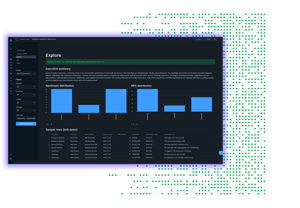
Once connected, it processes your free-text survey responses at scale. It classifies sentiment using NPS weighting methodology, giving more analytical weight to detractors so that critical issues are never buried by volume. It summarises findings by specialty, site, directorate, or date range and presents them in a clear dashboard your team can act on immediately.

When you need to go deeper, dynamic prompting lets you ask follow-up questions directly. You do not have to re-run the analysis or export the data elsewhere. The answers are in the tool.

Ready to move from reading feedback to improving care? Request a demo today.
Do any of these sound familiar?
Patient feedback should drive service improvement. In practice, most NHS data teams are still stuck reading through responses line by line, building manual spreadsheet summaries, and trying to spot patterns that should be obvious.
You have survey data. You don't have time to read it.
The Problem
NHS Trusts run Friends and Family Tests, national patient surveys, and service-specific feedback programmes simultaneously. The volume of free-text responses is significant. One acute Trust can receive thousands of comments per month across specialties, sites, and care pathways.
The Solution
Your data team is capable of serious analysis. But they can't do serious analysis while they're still reading comments. NHS Sentiment Assistant processes your entire response dataset automatically, classifies each response by sentiment, and delivers summarised findings in seconds. Your team moves straight to the insight.
Group 1 (1)-1

You can see the data, but you can't see the pattern.
Group 2 (1)
The Problem
A complaint about waiting times in one specialty might look isolated. But when the same issue appears across four departments and three sites over six weeks, it's a systemic problem. The challenge is that spotting that pattern manually requires time, consistency, and a single view of all responses.
The Solution
NHS Sentiment Assistant analyses feedback across specialties, directorates, and locations at once. It identifies recurring themes and flags emerging risks before they escalate. If the same issue keeps surfacing, the tool finds it, whether it appears in 10 responses or 1,000.

Your analysis is backward-looking by the time it's done.
The Problem
Most NHS organisations review patient feedback on a monthly or quarterly cycle. By the time responses are read, summarised, and shared, the care episode that generated the feedback is weeks old. Acting on it requires tracing back through systems that may no longer reflect current demand.
The Solution
With NHS Sentiment Assistant, sentiment analysis runs in real time against your Snowflake data or a direct CSV upload. You can filter by date range and track how sentiment changes week on week. You stop describing what happened last quarter and start responding to what is happening now.
Group 3-1

What does your team gain from using the NHS Sentiment Assistant App?

Hundreds of survey responses analysed in seconds, not hours. Your data team stops spending time on manual reading and starts spending it on improvement planning. NHS Sentiment Assistant processes bulk survey data automatically, delivering findings at a speed that manual analysis cannot match.  
NPS weighting that reflects the reality of patient experience. Responses are classified using standard Net Promoter Score methodology. Detractors (scores 0 to 6) are weighted more heavily, so critical patient concerns surface clearly rather than being diluted by overall volume. Your analysis reflects the true distribution of satisfaction, not just the average.  
Cross-service pattern detection that manual review misses. The tool analyses feedback across multiple specialties, sites, and directorates simultaneously. Repeated complaints, recurring themes, and emerging risks are identified across your full dataset, not just within individual service lines.  
Real-time filtering so your analysis stays current. Filter by date range to track sentiment over time, or narrow to a specific site or care pathway to focus on a particular concern. When your data in Snowflake updates, your analysis reflects it.  
A tool your team can use without a data engineering project. NHS Sentiment Assistant is available through the Snowflake Marketplace. Installation is straightforward. Flexible column mapping means it works with your existing survey data structure, without requiring a rebuild of how you collect or store feedback.  
Dynamic prompting so your team can investigate without leaving the tool. When summarised findings raise a question, you can ask it directly. Dynamic prompting lets you drill into specific areas of concern without re-running analysis or exporting data elsewhere. The investigation happens in the same place as the insight.  

How the NHS Sentiment Assistant App Works

1
Connect your data
Ingest survey responses from a Snowflake table or upload a CSV/XLSX file. Flexible column mapping means your existing data structure does not need to change.
2
Apply your filters
Narrow analysis by specialty, date range, site, directorate, or trust level.
3
Run the analysis
AI processes responses, classifies sentiment, applies NPS weighting, and evaluates feedback across your filtered dataset.
4
Review summarised findings
A clear dashboard surfaces key themes, sentiment breakdowns, and flagged concerns.
5
Drill down on what matters
Use dynamic prompting to investigate specific issues in depth without leaving the tool.
6
*Limitations
AI-generated summaries and actions are advisory and should be reviewed by qualified personnel before implementation.

Request a demo and see how your survey data looks when it's analysed at scale.

Most NHS data teams are already sitting on months of unanalysed patient feedback. The comments are there. The patterns are there. The question is whether your team has time to find them.

NHS Sentiment Assistant gives you that time back.