
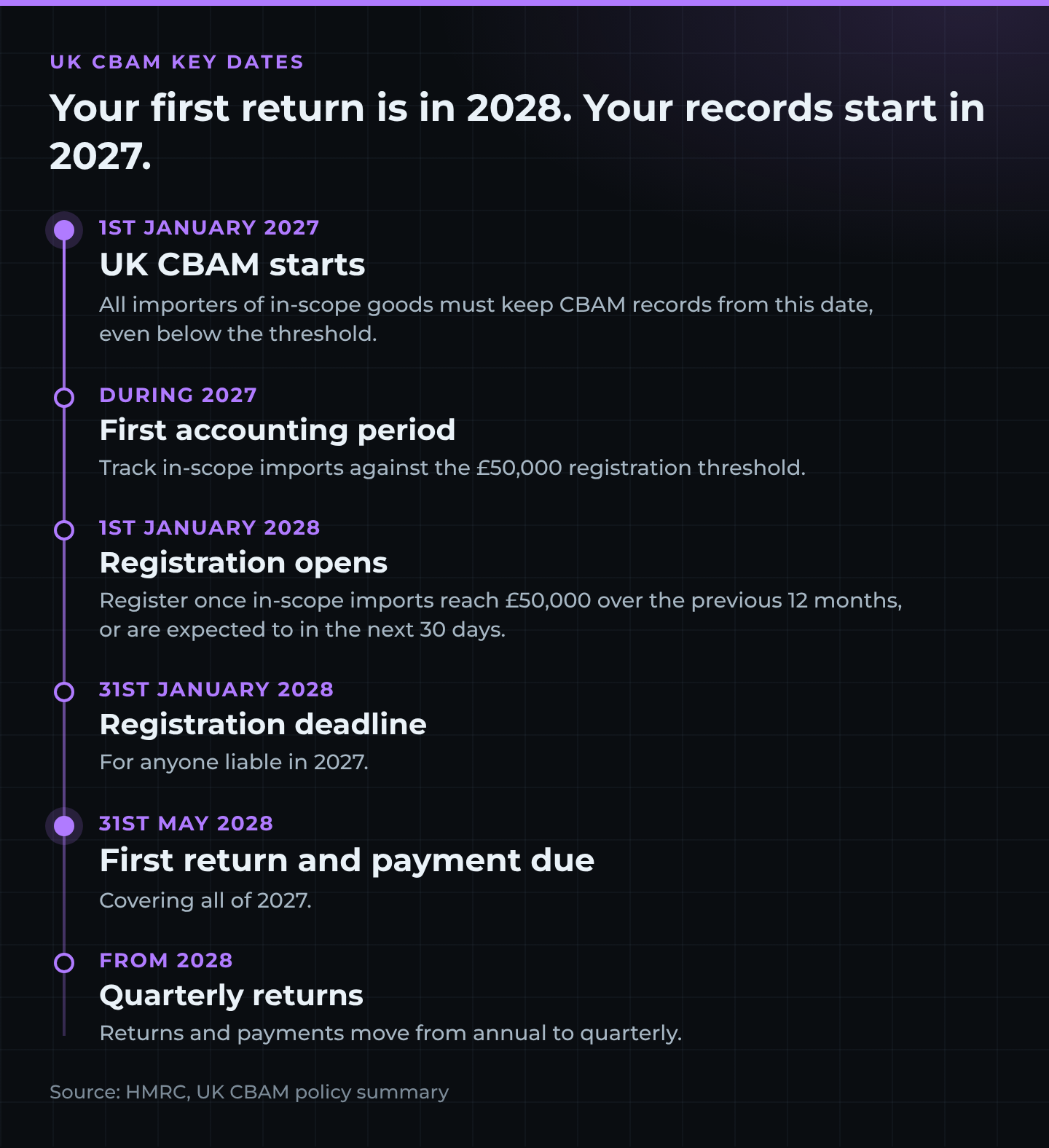
Your first UK Carbon Border Adjustment Mechanism (CBAM) return isn’t due until 31st May 2028. But the data behind it starts on 1st January 2027. From that date, every importer of in-scope goods must keep CBAM records, even if they never reach the registration threshold.
The rules are also becoming concrete. On 16th October 2026, HMRC published the default emissions values and illustrative rates for each sector. That means the choice between verified actual emissions and default values is one you can start modelling now.
Compliance depends on data spread across customs, procurement, finance, supplier, carbon accounting and ERP systems. When those systems don’t connect, gathering the evidence for each calculation becomes manual work.
This checklist helps you test your UK CBAM data readiness before the deadline, and shows where better integration, governance and reporting cut risk and manual work.
In this article
What is UK CBAM and why is it being introduced?
UK CBAM is a carbon charge on specific carbon-intensive goods imported into the UK, including Northern Ireland, from 1st January 2027. HMRC’s UK CBAM 2027 policy summary sets out the detail.
It exists to stop carbon leakage. UK producers pay a carbon price through the UK Emissions Trading Scheme (UK ETS), so CBAM puts a comparable price on the emissions embodied in imports. For manufacturing businesses buying in-scope materials from abroad, that means a new cost line and a new reporting obligation.
How is UK CBAM different from EU CBAM?
The schemes are separate, so meeting one doesn’t mean you meet the other. EU CBAM entered its definitive phase on 1st January 2026, also covers electricity and uses a 50-tonne annual threshold for most goods. UK CBAM uses a £50,000 value threshold and is run by HMRC. If you import into both, plan for two sets of rules and returns.
| UK CBAM | EU CBAM | |
|---|---|---|
| Starts | 1st January 2027 | Definitive phase from 1st January 2026 |
| Registration threshold | £50,000 of in-scope imports (by value) | 50 tonnes a year for most goods |
| Electricity | Not one of the five sectors | Covered |
Which manufacturers and goods will be affected by UK CBAM?
UK CBAM applies to specified imported goods in five sectors: aluminium, cement, fertiliser, hydrogen, and iron and steel.
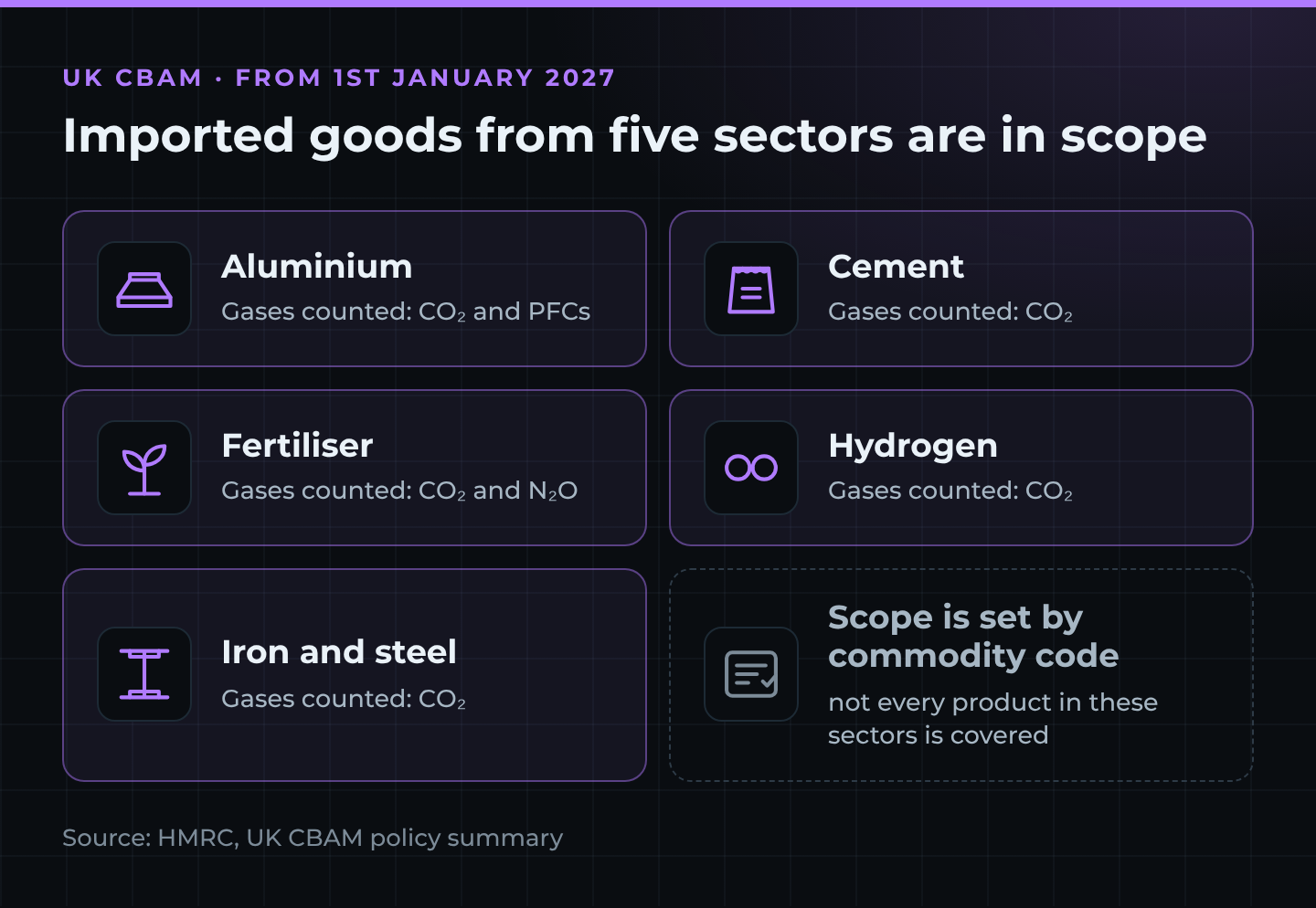
Not every product in those sectors is automatically included. Scope is set by commodity code, so the same material can be in or out depending on how it’s classified. Check each import against the official list of commodity codes within scope of CBAM, rather than assuming a product is covered or exempt.
Who is responsible for UK CBAM compliance?
The liable person is normally the importer: the person in whose name the customs declaration is made. Check this carefully where customs agents, group companies, overseas suppliers or indirect representatives are involved.
Check the latest HMRC guidance and take tax or legal advice when deciding scope and liability.
What are the key UK CBAM compliance responsibilities?
HMRC can charge penalties for late notification, returns or payment, for errors in returns and for failing to keep records.
How should manufacturers prepare for UK CBAM?
Readiness goes beyond checking scope. You need reliable customs and emissions data, a clear supplier data process, visibility of your financial exposure and an audit trail linking every calculation to its evidence.
Watch for one gap in particular. CBAM works at the level of individual goods, so site-level energy and emissions data isn’t enough on its own. We cover this in CBAM wants embedded emissions per product. Your data is per site.
What should a UK CBAM 2027 data readiness checklist include?
Use these ten checkpoints to test where you stand.
The checklist at a glance
1. Have you identified every in-scope import?
Build a baseline of imports in the five CBAM sectors. Capture the 8-digit commodity code and description, tax point date, value, net mass, origin, supplier, importing entity and any exemption evidence. Then fix missing, inconsistent or manually overridden codes.
2. Will you use actual or default emissions values?
HMRC published default values on 16th October 2026, and you must use them where you lack verified actual data. Model the cost of both approaches. Actual data won’t always lower your bill, so decide based on the evidence you can get.
3. Can you track liability and the threshold?
Confirm which entity is the importer for each flow of goods, and build a rolling view of in-scope import value against the £50,000 threshold. Registration opens in 2028, but the data behind it starts on 1st January 2027.
4. Have you mapped supplier emissions data?
Actual values depend on verified supplier data. Map in-scope suppliers, sites and products, what data exists and who owns it. Then send a consistent request covering production site, product or batch, methodology, emissions, reporting period and verification evidence.
5. Can you link evidence to individual imports?
A verification report proves little unless you can show which products, facility, period and imports it covers. Use shared identifiers across suppliers, products, commodity codes, consignments and declarations, and keep a record of which figures supported each return.
6. Are you capturing relief and exemption evidence?
Carbon price relief for carbon already paid overseas needs verified evidence, including the scheme, effective price, calculation method and exchange rate used. Keep evidence for exempt goods too, including UK-origin goods, Returned Goods Relief and temporary admission with full duty relief.
7. Is your calculation process governed?
CBAM combines customs, emissions, carbon price and financial data. Assign data owners, reviewers and approvers. Add controls for missing data, duplicates and manual adjustments, and document the logic so every figure traces back to source.
8. Can you keep a six-year audit trail?
HMRC requires records for six years from the later of their creation or the end of the accounting period they relate to. Your trail should hold customs documents, verification reports, calculations, relief evidence, approvals, returns and payments, and be complete, timestamped, attributable and version-controlled.
9. Will your reporting flag problems early?
BI lets you manage CBAM through the year rather than at the deadline. Useful alerts cover progress to the threshold, imports with missing codes or weights, emissions without valid verification, goods on default values and their cost, outstanding supplier requests, and mismatches between customs, finance and sustainability records. Our data analytics services help manufacturers build this reporting.
10. Have you run a full dry run?
Before January, trace a sample of imports through the whole process, from scope and liability to calculation, approval and evidence retrieval. Use the gaps you find to build a prioritised plan with owners and dates.
How can CBAM data inform wider supply chain decisions?
Once import, supplier and emissions data sit together, you can see which products and suppliers carry the most embodied carbon, model costs as quarterly rates change and compare sourcing options. That gives you the evidence to push for better supplier reporting, work with suppliers on decarbonisation, renegotiate contracts or explore alternative sourcing.
“Most manufacturers see CBAM as another report to file. The ones who get ahead will treat it as a new view of their supply chain. Once you can see the embedded carbon in every import, by supplier and by product, you can have very different conversations about sourcing, pricing and contracts. That only works if your customs, supplier and finance data are joined up from the start, not pieced together at year end.”Dan Packer, Account Director, Catalyst BI
How connected is your factory?
CBAM readiness depends on how well your operational, supplier and financial data join up. Our Connected Factory report looks at where UK manufacturers stand on data and AI, including CBAM and compliance.
To see how connected your factory really is, and what the gaps could be costing you. It’s ten questions and gives you a score out of ten.
Take the Connected Factory BenchmarkHow can Catalyst BI help you prepare your data for CBAM?
We’re a data and analytics partner, not a CBAM software vendor. Working with leading technology partners, we help manufacturers:
Is your manufacturing data ready for UK CBAM?
UK CBAM starts on 1st January 2027. Registration and the first return come later, but your records must be reliable from day one. Treat CBAM as a year-round discipline, not a year-end exercise: connected data, clear ownership and an audit trail you can retrieve at any time.
Assess your manufacturing data readiness with our Data Management Health Check.
FAQs
What is CBAM?
When does UK CBAM come into effect?
Which products are covered by UK CBAM?
What is the UK CBAM rate?
Who needs to register for UK CBAM?
What data do manufacturers need for CBAM reporting?
How long must CBAM records be kept?